
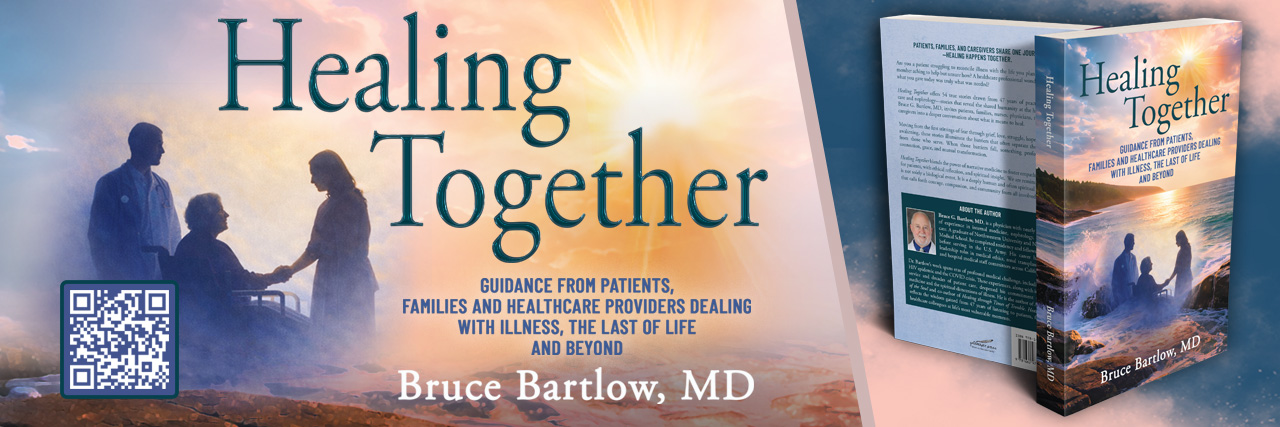
So many patients report grieving begins not at the end of an illness, but long before we first go to the doctor’s office. With that first symptom, we wonder if this could be “the big one” that will take us away. Have we lived well enough to deserve grace? What will we face if we haven’t? One patient in “Healing Together (2026)” describes her thoughts while getting her six-monthly CT follow-up for a malignancy. She finds herself dealing with everything from practical to spiritual issues. How will I set my husband up with a new wife if I die? What was the meaning of my life? Where am I going? Will I go there (if there is a “there”) alone? Am I blessed or doomed? Or suddenly irrelevant?
Historically, 26% of dialysis patients die each year. That means if we round on 4 chairs at the dialysis unit, one of those patients won’t be alive next year. Those figures are improving somewhat as we modify dialysis regimens, but when we find one of those four chairs empty we know what it means. The patients around that empty chair know what it means and that they may be next. Much of grieving is an inner process, but much of it is communal. HIPPA (the federal Health Information Privacy and Portability Act) has outlawed sharing even one word of support at such moments. Grief, reminiscence – how we honor the dead – have been governmentally terminated.
What is the experience of grieving?
In Chapter 8 of “Healing Together” is what Denise Eillers RN emailed me about her 23 years dialyzing her husband at home. They were very good years, but the first thing she said about the last 6 months was the grieving:
Grief was not a huge, terrifying abyss that I struggled my entire life to evade. Rather, it evolved during many small losses, such as daily having to do more for Jerry in ways so incremental they were barely noticeable. It came from the slight reductions in capability, invisible to healthcare providers. Talking about the next vacation we knew we wouldn’t take. Thinking about what I’d do once he’d died, then feeling guilty about that. There was more than enough guilt to go around. So for me grieving started early, as I believe it does for most renal patients and their families, perhaps with the first elevated creatinine level, or the imprint of the socks on ankles swollen from renal insufficiency. But now, bereavement feels like a shrine to me, in which I experience many things:
- Writing a journal
- Sacred and yearning feelings
- Reality and unreality
- Guilt and cherishing
- Past and present mixed
- Yearning to forget, yet fearing it
- Guilt for feeling joy now, when he can’t share it
- Amazement at how this dear one was cherished by those who knew him
- Living with the absence of the one who shared a thousand intimate memories
Are these what doctors and nurses do at the end of an illness? Do we make room to recognize our grieving? We’re aware that we’ve lost someone and it’s time to move on. How often do we suspect there’s something more we should have done? Is that “something” another diagnosis, another procedure? Or perhaps it’s taking time to share in the grieving?
Is this secret guilt only mine? In Kitchen Table Wisdom (2006), Rachel Ramen wrote several chapters that end when a physician who’s run out of technologic treatments says to a patient who asks what comes next, “I have nothing left to offer you.” Rachel responds how wrong that statement is. In my own opinion, this refusal of care presumes that a physician’s only value is in providing a cure. Are we that shallow, or only that locked down?
Our patients and their families have been in a relationship with us, whether it lasted only a few days or stretched for decades. To abandon them and withdraw our expertise and empathy at a crucial time inflicts an additional wound.
I’d like to take that a step farther. It seems much safer to be a caregiver than a care receiver. When we feel secure behind all of our stereotypes – the perfect doctor, the always compassionate nurse, the therapist following orders, the patient whose job is to comply – we’ve closed off what is required to heal. God didn’t invent grieving on a bad hair day. She or He knew that grieving begins with the first worrisome symptom and continues for months or years after we leave this world.
When we refuse to recognize that we’re grieving, we block the healing we came to this work to achieve for ourselves and our patients. Grieving evolved as a series of steps to wrap ourselves around this new reality without the person, or the capabilities, or the illusions we’ve lost. Probably all societies and all religions have structures to reinforce these practices. We ignore them at our own peril.
Leave a Reply